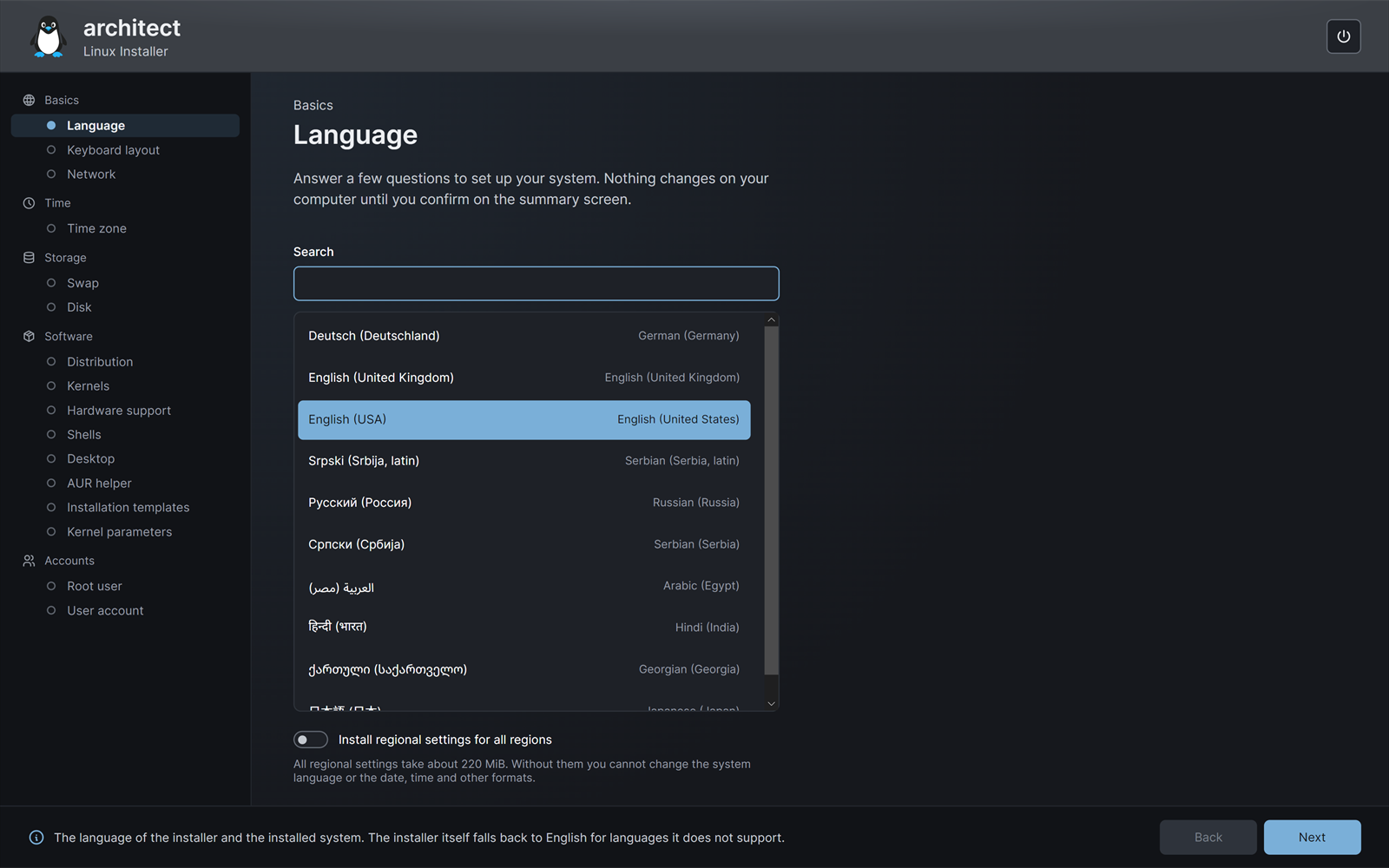
Architect is a bootable image with a graphical installer that installs a Linux distribution on the machine it boots on.
Supported distributions
- Arch Linux
- Debian 13 (trixie)
- Fedora 44
Download
| Channel | Version | Date | Size | Files |
|---|---|---|---|---|
| Release | Loading… | |||
| Beta | Loading… | |||
A release is built from a v<major>.<minor>.<patch> tag. A beta is built from
the latest commit on master and may break. Verify a download with
sha256sum -c architect-<version>-x86_64.iso.sha256.
Why Architect
You install Linux more than once: a laptop, a desktop, a home server, a few virtual machines. Each distribution's own installer asks its own questions, draws the line at a different place when it comes to encryption, LVM or RAID, and keeps its answers in a format the next distribution cannot read. Architect replaces them with one wizard whose answers are the same whatever you install.
Storage setups that otherwise mean a terminal session, such as an encrypted LVM with thin pools on a RAID mirror or btrfs with subvolumes and snapshots, are a few wizard pages here, with the whole layout reviewed on one screen before anything is written. Before that screen the installer has already asked the mirror for every package it will need, so a typo in a package list or a dead mirror stops the installation while your disks are still untouched.
The wizard's answers can be saved and reused on the next machine; see Unattended installation.
Features
Storage
Automatic layout on one disk, or a partition editor for any number of disks. RAID, encryption and LVM stack in that order, each optional.
- RAID: levels 0, 1, 5, 6, 10
- Encryption: LUKS2
- LVM: plain volumes, thin pools
- File systems: ext4, btrfs with subvolumes and snapshots
- Firmware: UEFI, BIOS
- Partition tables: GPT, MBR
- Swap: partition, logical volume, file, zram, hibernation, zswap
- Reuse of existing volumes: partitions, LUKS containers, volume groups, RAID arrays
Software
The installed system is the distribution's own: its packages from its repositories, its package manager, its boot loader and its update path. Architect chooses only the initial set of packages and writes the initial configuration, so afterwards you add another desktop environment, swap the kernel or remove anything the wizard installed with the distribution's usual tools. The wizard offers:
- KDE Plasma desktop, full or minimal
- Choice of display manager, SDDM, GDM, LightDM and others
- Kernel flavour: stable, LTS, Zen or hardened (Arch Linux only)
- Desktop applications by category, each from the distribution's repositories or from Flathub
- Choice of login shell, Bash, Zsh, Fish and others
- Roles such as file server, SSH access, virtualization host or gaming (gaming on Arch Linux and Fedora)
- AUR helper (Arch Linux only)
- Btrfs snapshots
- Proprietary GPU drivers, offered when the installer detects the GPU
- Guest tools, offered when the installer detects the hypervisor
- Fixes for specific laptop models and devices, offered when the installer detects the hardware
Unattended installation
The finish page saves the configuration as unattended.json after an interactive installation. An
ISO carrying that file at /architect-installer/unattended.json skips the wizard and installs after a
countdown. The installer applies only the templates that match the machine's hardware, so one file serves
different machines.
Usage
Write the image to a USB stick and boot it. Root logs in on the first console and the installer starts;
architect-installer starts it again. Flags:
--debugshows every external command in a log panel on the progress page.--finstalls unattended with the default configuration. The first console login sets the root password.
Exit codes: 0 success, 1 cancelled before installation started, 2 installation failed. The install log is at
/tmp/architect.install.log on the live system.
Source and license
The source, the build instructions and the third-party notices are at git.oddbit.io/oddbit/app-architect-core. Architect is licensed under the GNU General Public License version 2.
An ODDBIT project.